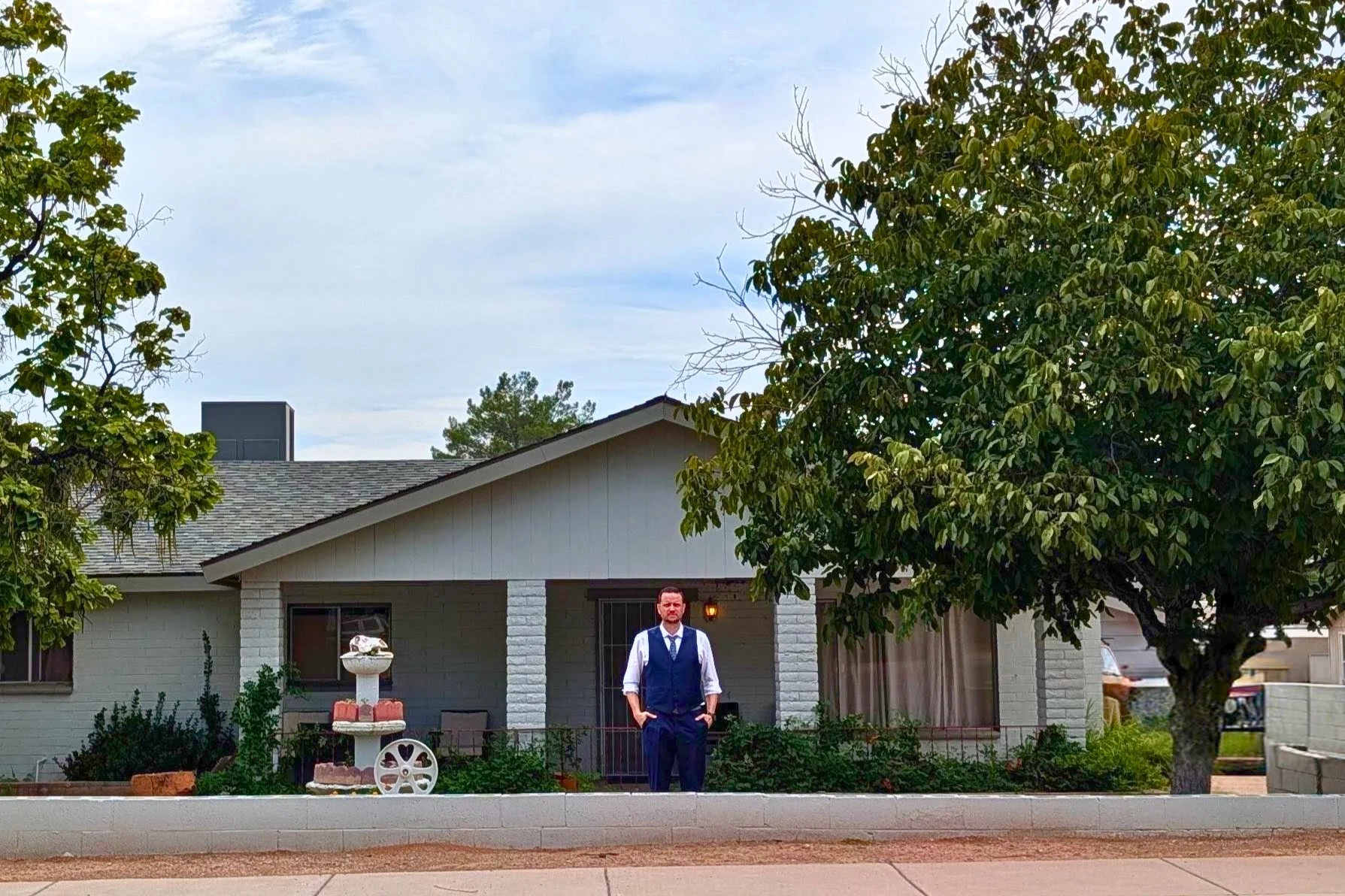
Brian Webb is a second-generation Arizonan and founder of The 928 Law Firm, a Flagstaff-based practice focused on serving rural Arizona. He fell in love with Flagstaff as a law student, began his career in nonprofit legal services, and later built a small business here.
But earlier this year, Brian bought a home in Cottonwood, not Flagstaff. His experience shows how Flagstaff’s housing shortage reaches beyond individual households: It shapes who local employers can hire, who they can keep, and whether small businesses can grow.
What first brought you to Flagstaff?
I’m a second-generation Arizonan. I grew up in the northwest Valley back when it was dirt roads, cotton fields, and citrus groves.
My dad was a union plumber, and my mom mostly stayed at home and worked a little on weekends. On basically one blue-collar income, they were able to buy more than an acre, build the house I grew up in, and steadily remodel it over the years. I got to see what housing affordability looked like for their generation.
I went to ASU for undergrad and law school. During law school, I was driving to Flagstaff and northern Arizona nearly every weekend to camp, fish, kayak, and hunt. Eventually I thought, “If I’m putting up with Phoenix traffic to get up here every weekend, I should probably just live in northern Arizona.”
In the summer of 2008, I interned at the Flagstaff office of DNA-People’s Legal Services, a nonprofit law firm based on the Navajo Nation, and really fell in love with Flagstaff. I started my career with DNA after law school, originally in Tuba City, and eventually moved to Flagstaff.
A few years out of school, my partner at the time and I bought a house in Cosnino on an acre backing national forest for around $200,000. We were on nonprofit and government salaries. Even then, housing was so much more affordable and accessible.
Why is homeownership important to you?
I saw homeownership help my parents accumulate wealth over time. And as a lawyer, I’ve worked on hundreds of divorce cases. For a lot of middle-class families, the house is their only real asset. It’s their only real “savings account” or wealth-building device.
People often don’t have much money left at the end of every month to put into savings, especially in Flagstaff, where the cost of living is so high. But if you can get into homeownership, the property can increase in value over time.
The problem now is getting in.
When did you realize buying in Flagstaff was no longer realistic?
Honestly, this time around I knew better than to look very seriously.
My biggest moments of sticker shock came earlier. Maybe eight years ago, I remember searching Flagstaff listings for homes priced at $300,000 or less. The results were basically all double-wides.
Later, I looked at a house priced around $700,000 or $800,000 that was still a fixer-upper. It needed paint, flooring, cabinets, and a lot of other work. I even remember a broken mirror during the walkthrough. You could spend that much and still need to put tens of thousands of dollars into the house.
When I moved back north this year after spending a couple years in Phoenix for family reasons, my rough sense was that even a starter home in Flagstaff—something site-built that probably still needed work—would cost around $500,000. If you want to make a 20% down payment, that means coming up with $100,000.
For me, as a lawyer 15 years into my career, buying in Flagstaff felt somewhere between inaccessible and imprudent.
And renting doesn’t necessarily create a path to ownership. If your rent is expensive, it’s hard to save for a down payment. You may end up putting other expenses on credit cards, which can hurt your credit and make a future mortgage more expensive.
Living in Flagstaff can become a downward financial spiral for people, or a flatline at best. It’s really hard to get ahead if you don’t already own property.
How did you end up buying in Cottonwood instead?
My mom owned a property in Cottonwood that my parents had been remodeling before my dad passed away. After he died, my mom wasn’t really able to keep working on it, and she eventually rented it out.
When I was looking to move back to northern Arizona, the property was becoming vacant. I worked something out with my mom and bought it for about $350,000, which was around the appraised value.
It’s a modest home from the early 1970s on about seven-tenths of an acre, and it still needs significant updates. Some of the work my parents had already done, and some of it I’m finishing now.
There’s also a sentimental part of it for me: I’m able to finish the project my parents were working on before my dad passed away. In that sense, I’m carrying it on for my family.
But the financial difference matters too. I would guess that a similar property in Flagstaff could cost around twice as much.
At times, I almost feel like I’m quitting on Flagstaff by not living in the town where I have my business. But I also have long-term financial goals for myself. My hope is to finish the work here, build equity, and potentially use that to make a down payment on a place in Flagstaff a few years from now.
What has living an hour away cost you as a business owner?
I’m only physically in the Flagstaff office two or three days a month right now, which is not ideal from a staffing and supervision standpoint.
From a strictly business perspective, I believe the founder of a company should be in the office every day, or at least most days. When I bought the house in Cottonwood, I thought I might work in Flagstaff every Monday and Tuesday—drive up Monday morning, stay overnight, and come back Tuesday.
But a round trip can take around four hours – there’s getting gas, packing, and everything else that goes with it. It’s difficult to justify spending those four hours when I can sit down at my home office and spend those same four hours working on the firm.
There are competing interests. It’s better for the business in one sense for me to spend those hours generating revenue. But it’s also better for the business for me to be physically present with our staff.
That’s the trade-off. It was hard to choose to live in Flagstaff when doing so might have kept me out of homeownership for years.
How can housing be a recruitment problem when you’re offering attorneys around $100,000 a year?
Flagstaff has a small legal community, and NAU doesn’t have a law school. We either need to find somebody who is already here or persuade someone from another city or state to relocate.
We can offer a new attorney around $90,000 or $100,000 a year when you include benefits such as health insurance subsidies, 401(k) matching, and other compensation. Then they look at their housing options.
They are looking at around $2,000 a month for a one-bedroom apartment, plus a $3,000 security deposit. If they want a house with a yard, they may be looking at $3,000 or $4,000 a month in rent unless they have roommates.
But somebody relocating to town probably doesn’t know anyone to live with.
If they want to buy, what 25-year-old law school graduate has $50,000 sitting around for a 10% down payment? Most likely, they don’t.
Even at around $100,000 a year, it’s really hard to recruit someone to Flagstaff.
You finally recruited a young attorney to Flagstaff. What happened?
We recruited nationally and found someone willing to work for us. Once he became licensed in Arizona, he moved to Flagstaff. He really enjoyed the state. He got a state parks pass, traveled around Arizona and the Southwest, played golf, and spent time outdoors.
But at the end of his one-year lease, he decided not to stay. He found another job and moved to Phoenix, where housing was more affordable and he had more friends and social connections.
We had a good relationship, so he gave me a candid exit interview. Housing costs were part of the decision. It wasn’t the only factor, but it was an important one. His view was essentially: if he was going to spend that much on housing, he could live in the Phoenix area near his friends.
There were no hard feelings. I expect everyone to do what’s best for themselves and their families.
But as you can imagine, it’s not our business model to train lawyers through the first year of their careers and then have them move away. We invested months in recruiting and training him. Financially, this was not an ideal outcome for the firm.
Have other employees had to leave Flagstaff to get ahead?
In a period of roughly two years, we had three employees relocate out of state while continuing to work for us remotely. We didn’t want to lose them.
One was a key paralegal and case manager who trains and supervises most of our new non-lawyer staff. She was sharing an apartment in Flagstaff and paying roughly $1,000 a month, even with what was probably a friends-and-family discount.
She moved to southern New Mexico and pays much less now. It has been really cool to see that she can now take vacations in a way she never could before because she has more financial flexibility. I’m happy for her.
But that came at a cost to the firm. She is our longest-tenured employee—the longest-tenured person other than me—and she is the person who trains much of our staff. We were able to retain her remotely, but we lost her day-to-day presence in the office.
For her to get ahead financially, she had to leave Flagstaff.
What kind of life do you want your employees to be able to build?
At our strategic planning meeting this year, my partner and I talked about what we want the next phase of the firm to look like.
We want the firm to be financially strong, and we want to pay our career-track employees well enough that they want to stay with us long-term. That includes attorneys, paralegals, legal assistants, and other staff who see this as a career rather than a temporary job.
We want them to be able to contribute to the 401(k) we provide and save for retirement. We want them to be able to get a passport, take a week or two off, and travel. We want them to be able to buy a house and start a family.
Some of these employees may be 22-year-old college graduates when they start with us. The question is: how much would we have to pay them to make those things possible in Flagstaff?
We’re trying to pay above average. We don’t want our employees to be perpetually locked out of homeownership.
Where does housing rank among the barriers to growing your business?
For my business, it’s near the top. You could make the argument that it’s the biggest problem, or at least one of the biggest.
Flagstaff has a great labor pool for positions such as legal assistants, receptionists, and paralegals. There are a lot of bright college graduates who are enthusiastic and good with technology.
But you can’t grow a law firm with an army of non-lawyers. You have to add attorneys, and then add support staff to help them.
We are currently a two-lawyer firm. For a 20-lawyer firm, adding one attorney only increases its attorney workforce by 5%. For us, adding one attorney is a 50% increase. That’s a much bigger financial risk.
We either need enough cash reserves to operate at a deficit while the new attorney is training and building a caseload, or we have to take on more work than we can comfortably handle and bet that we’ll be able to find someone.
If we offer $120,000 or $140,000 to persuade an attorney to relocate, we run a deficit of $10,000 to $15,000 a month while that person gets up to speed. Then, if they leave after a year, we absorb the recruiting costs, the training costs, the salary, and all the time we spent helping them become productive.
When we lose an attorney, we also don’t need as many support staff. We haven’t laid people off, but when employees leave, we may not replace them because we no longer have enough legal work to support those positions.
The economic incentive in Flagstaff is to not grow your firm.
What should Flagstaff’s leaders understand from your experience?
It is really, really hard to grow a business in Flagstaff without affordable housing—and that’s coming from somebody who is offering young attorneys around $100,000 a year.
I’ve spoken with leaders at other law firms, government offices, and nonprofit legal organizations, and they’ve experienced the same recruitment problems. I would be shocked if other small-business owners said housing costs were not limiting Flagstaff’s economic vitality.
Housing affects whether people can come here. It affects whether they stay. It affects whether local businesses invest in training them, whether those businesses can grow, and whether employees can build stable lives.
I expect everyone to do what is best for themselves and their families. But in Flagstaff, sticking with one employer for decades is increasingly unlikely to be the best financial choice for someone’s family.
That is a problem for workers, for local employers, and for the future of the community.
